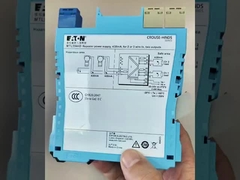
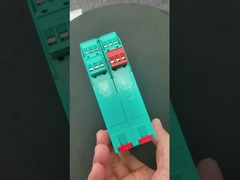
Brief: From concept to demonstration, this video highlights the evolution and practical outcomes of the Pepperl+Fuchs KFD2-SL2-EX2 2-channel isolated barrier. You'll see how this high-performance solenoid driver is engineered for hazardous industrial areas, featuring a detailed walkthrough of its robust galvanic isolation, precise signal control, and advanced line fault detection capabilities.
Related Product Features:
Provides robust 2-channel galvanic isolation with reinforced insulation for safe operation in hazardous areas.
Features advanced line fault detection for short-circuit and open-circuit conditions to ensure system reliability.
Designed for SIL 2 compliance according to IEC/EN 61508, meeting global safety standards.
Supports digital output signals with a maximum output current of ≤ 45 mA and minimum output voltage of ≥ 11.7 V.
Operates with a wide power supply range of 20-30 V DC and low power consumption up to 3.3 W.
Includes configurable DIP switches and LED indicators for easy setup and status monitoring.
Compact B2 housing with IP20 protection and DIN rail mounting for versatile industrial installation.
Certified with EU-Type Examination Certificate ZELM 00 ATEX 0024 for use in explosive atmospheres.
FAQs:
What safety standards does the KFD2-SL2-EX2 isolated barrier comply with?
The KFD2-SL2-EX2 complies with SIL 2 according to IEC/EN 61508 and carries the EU-Type Examination Certificate ZELM 00 ATEX 0024, making it suitable for use in hazardous areas classified as Ex ia.
How is the line fault detection feature configured and what does it monitor?
The line fault detection automatically monitors for short-circuit conditions below 50 Ω and open-circuit conditions above 10 kΩ using a test current of less than 650 µA, enhancing operational safety and reliability.
What are the mounting and environmental specifications for this isolated barrier?
It is designed for mounting on a 35 mm DIN rail, operates in ambient temperatures from -20 to 50 °C, and has an IP20 degree of protection for indoor industrial environments.